Archive for the 'Misc' Category

02
Sep
11

Without a # Tag. Somalia.

I’ve recently returned from a trip to Dadaab, the world’s largest refugee camp. I was asked to join the Al Jazeera Director General on this trip in order to help create greater awareness about the situation through “new media” tools. Having read about the stories coming out of Somalia and looking through a ton of photo galleries and videos I thought that I had somewhat prepared myself for the trip.

I could not have been more wrong.

For the first time in my life, I now know what it means when people say “words cannot describe what I’ve seen.” It was tough. Very tough. The people who make it to Dadaab are the “lucky” ones – others have perished on the side of the road, on their way to Dadaab.

The stories that were told were… devastating. Parents having to decide which child to leave behind so that they could make sure the fittest would be able to make it to camp. Imagine having to leave your weakest child behind, on the side of the road, to die. That’s it. Left for the vultures. The lucky ones will die before and at least get a burial. Another told a story of how his baby had to breast feed of his dead wife so that they could have enough strength to go on with the journey.

I felt ashamed to call myself a human being.

There are countless more stories like this, they’ve been told over and over and over. The thing that has hit me most about this, is that it’s not new. Dadaab has been around for over 20 years. Famine and drought are known to occur in these places, yet year after year people are dying of starvation.  Why?

As I sat down on my comfy hotel bed back in Nairobi (only an hour flight away), realising the cruel irony of having a rain shower in the bathroom was a bit too much too handle. We are all living so close to this disaster. In 2011, with all our technology and knowledge, we’re not able to stop people from dying of starvation? That’s hard to believe. How have we as humanity failed these people? We have tons of donations*, but often our donations go without a sense of purpose and attachment to the story. Sending aid does not deal with the core issues that exist. People will get the aid today, what about tomorrow, next month, 5 years from now?  (*the aid that is going is far from enough)

We met people standing in queues to just get one meal for the day. People who are fighting for the right to live. For human dignity. For just a chance. That’s all they want. A chance at life.

Looking into the eyes of children you always get a sense of joy, a sense of optimism that can defeat anything. When I looked into the eyes of some of the children in the camps they looked defeated, worn out, life had taken its toll on them. I’m talking about children who are not older than 3 years old. They’re still the lucky ones. Seeing babies who are malnourished, children without the strength to even stand. The skeletal structure of a living human. This is Dadaab. This is our problem.
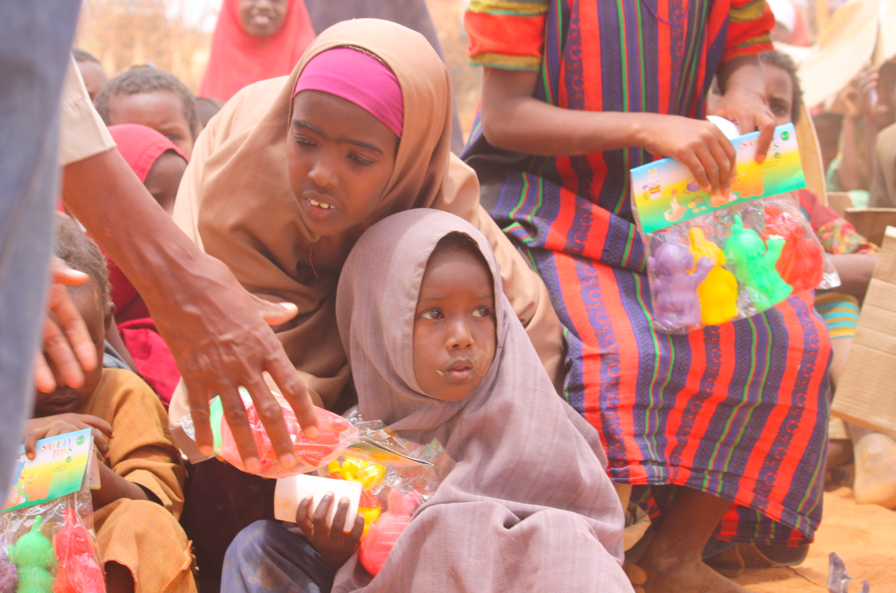
Yet, the story goes mostly unnoticed. Once in a while people will talk about it in the media, there will be hype for a bit, and then the search for a new story moves on. And we forget that the old story has not ended. In fact it’s grown to proportions beyond anyone’s imagination.

With the world of Social Media, everyone likes to talk about how technology can overthrow governments and change the world. How it can mobilise people around a cause almost instantaneously. How we always know what is happening, at any time, anywhere in the world.

Not this world.

When people have not eaten for weeks, have just enough cloth to cover a bit of their body, the last thing that is going to happen is for them to start a revolution with a # tag to get the world’s attention by telling their own story. They need us to do it for them. They need us to be the ones to show the world what’s happening.

As I type this, the trending topics on twitter look something like this:

I don’t actually think that I’ve ever seen Somalia trending on twitter. Ever. Will the world only pay attention when it makes it to the top of the trending topic list? When it gets it’s own special # tag? When it becomes “cool” to join a cause? Maybe if lady gaga was to visit Somalia it’ll trend? She could maybe take her meat dress with her and put it to good use?

What is happening in the world is real. The stories out of Somalia are not some movie. Visting Dadaab felt like I was going to a different planet. I still can not believe that a couple of hours away from me, someone is about to die because they do not have enough to eat. It’s just so real. A realness that’s disturbing, that’s uncomfortable. One that is easy to pass on as not our problem, because if we acknowledge it, the sheer weight that falls on our shoulders to make a difference becomes frighteningly unbearable.

I type this while I’m sitting at home, with my fridge stocked, countless food places to get food from and with the luxury of eating to enjoy the taste of the food. Where did it all go wrong? How can we, as humanity, sit back and let this continue? We have all seen the videos. We have seen the pictures. We’ve heard the stories. What are we going to do about it? At the very least let’s tell the world what’s going on. Be the # tag the people in Somalia need us to be, for the sake of our humanity. If we cannot even get #somalia to trend, then I’m scared for what the future holds for us as a human race.

If only we paid as much attention to the African Summers as we did to the Arab Spring.

14
Jan
11

The revolution was televised, you were just watching the wrong channel.

One of the reasons I decided to post about this was this article on TechCrunch: The #Tunisian Revolution Wasn’t Televized, But You Could Follow It On Twitter

The first tweet that show’s up on the page is really the point behind this post.

The revolution was televised, you were just watching the wrong channel.

There is a lot to say about the role Social Media played in this, I do think that a lot of people seem to be missing the point on what exactly Social Media can and does do in shaping events. Think back to the Iran Elections and how the lack of context really sent many main stream media organisations down the wrong path on how to cover an event using stories from social networks. If my memory serves me correctly, at one point during the IranElections we had over 250,000 tweets using the tag #iranelections – I wonder how many tweets came out about #sidibouzid?

In Tunisia, it was not about mobilising people through Social Media, it was about broadcasting what was going on to those who chose to listen. Without the tweets, facebook posts or YouTube videos we would not have known about the initial protests… or would we? Only once mainstream media picks up on a story and decides what importance it should have, do people really notice what is going on (Iran Elecations case in point). Tunisia has been developing for the past 29 days – but only now do people seem to really notice it, once they’ve seen the news on their local television station. People still turn to mainstream media to get their information. The challenge is in what mainstream media would consider to be important news… The techcrunch article has a couple of other good tweets discussing what other media organisations in the US were talking about during the events earlier in Tunisia.

Evgeny Morozov has a great post on the this topic and it is well worth a read.

If you only found out about the events in Tunisa in the past 24hours, perhaps its time for you reconsider who you get your news from? A good start would be to check out the amazing coverage our web team has been working on since the events started almost a month ago over here.

And if you dont want to miss the next big story because your twitter trends didn’t tell you about it, you may want to set Al Jazeera as your homepage, or follow us on twitter or follow us on facebook.

10
Aug
09

Data Roaming Woes

This post is pretty longas it has about 8 months worth info in it.

The past 8 months have been pretty interesting (or annoying), I’ve been bouncing up and down with one of the local mobile operators in South Africa regarding an error on my data roaming bill. I’m not sure if I should mention the companies name yet or not, as the case is still currently open (I am tempted to though).

I know quite a lot of people have received huge shocks on their bill when data roaming, it is no doubt expensive. As it turns out though, telco’s can and do sometimes make mistakes with their billing. The problem is, without any sort of technical knowledge, you’re most likely going to land up paying the bill, as the telco will not really look into the validity of each and every line item.

Fortunately, I have an awesome network of colleagues, who are in the field. All of whom have been able to look at the details of the bill and see that there are some technical irregularities that need further clarification.

What is really interesting in all of this, is the repeated attempts from the telco and the service provider whom we have a contract with, to bully us into paying the account. For 8 months, we have repeatedly sent information proving the technical impossibilities of the case. Yet, they seem to come back with the same generic responses without actually responding to our main concerns…. One such example is the possible manipulation of dates in emails chains to make the responses seem more relevant… which was quite shocking.

In July our service provider called up and insisted that the telco had verified the charges are correct and as such payment needs to be made, as the case has been pending for 8 months. When we asked our service provider to send us the official response from the network in July, she forwarded us an email with the telco’s reponse. The forwarded email was the same response we received back in March, to which we had responded with a list of questions for clarification (no response was received).

The email chain had three parts:
1) Her opening statement saying “please see the response below from the network representitive” (this was dated July 16th)
2) The middle part of the mail was the response from the network, which did not have any date, but was a copy and paste from an email that was sent through to us previously on March 5th.
3) The bottom bit of the email chain was a request from her manager to network to “provide clarification on our dispute” this was request was dated July 15th

It is quite alarming that service providers can resort to such tactics in order to force payment from unsuspecting clients. I do wonder how many people have been forced into making payments that were incorrect.

Here are the details of the actual dispute….

In December ’08 – I was roaming with a South African sim card in the UAE. On December 23rd we received an itimised bill for an amount around R4,000 – this was alright as the data roaming charges are ridiculously priced… around R175 per MB.

On January 16th, we were sent an updated bill…. with one additional line item, for the value of around R61,000 (crazy, I know). Which stated that the one line item had +-430 megabytes of data downloaded during that session (on a mobile phone).

After sending through the calculations numerous times, the reply we received from the network was that:

The calculations were made by Mr. Minty and he does not have any knowledge or training on how the telco rates or bills data”

I had no idea we needed to present our credentials through to a telco in order to dispute a case. Thats some great customer services for you. After checking the calculations with various experts, they all do agree, that the calculations are valid.

The funny thing, the contact at the telco who is dealing with us, has his profile up on linkedin. He is hardly qualified to talk about data roaming and calculations, he lists his strengths as Call Centre Management, CRM Management, Vendor Management and few others. None of which are related to any technical analysis of data…. You have to love social media ;-)

I know that no download happened, as I was asleep at the time. The call data logs on my device (which I had for a 6 months before the event) show a total data usage of only 138MB. The itimised bill does not have any time stamp on the actual duration of the session, if I was to look at the next line item in the bill, the time duration between the two incidents is around 6 hours. I also serioulsy doubt that the battery of the device would have lasted for 6 hours with an active GPRS connection.

Essentially, I would have needed to download 430 megabytes on a Nokia N82 devices in 6 hours. After doing some research, it turns out, the network I was roaming on, only has a GPRS roaming agreement with the foreign network in the UAE. Call centres from both networks have confirmed that the roaming agreement means that the maximum data speed I could receive at any time would be a GPRS connection. The foreign network confirmed that the speed of their GPRS network is 48kilobits/second

So, if I was to assume that I was able to receive the maximum possible bandwidth (48kbps) it would have taken me around 21 hours to download 441 megabytes.

The calulation I used was as follows:
48 kilobits per second = 0.005859375 megabytes per second
0.005859375 * 60 seconds (one minute) = 0.352 megabytes per minute
0.352 megabytes per minute * 60 (one hour) = 21 megabytes per hour

So in 6 hours I would have been able to download 126 megabytes (6*21)
And in 21 hours I will be able to download 441 megabytes

The response from the network to the calculations was:

Perhaps this example can explain better; you open your email and you establish a connection with your email ISP or server. Your inbox starts to update and every bit of information has a data size and gets downloaded to your device in packets of varying size as and when a timeslot is available. So, whilst your email is updating, you decide to check out the news and you open your browser. As soon as this happens, whatever you see is updated which again is data sent.

The key point that they have missed, is that the total maximum bandwidth thats available is 48kbps. So, the data rates will be split in order to suit the amount of web applications that are running. So I could be downloading a file, opening email and browsing 5 different websites, the bottom line is that everything will take very long to load as I only have 48kbps available.

I also looked at the average data speed for the 3 data sessions that happened prior to the event happening.

Here are the calculations for the average speeds:
Session One (Line Item 75 and 76):
Between 23:23:59 and 23:33:33
Total Possible Time between items in Seconds: 574 seconds
Total Data used: 113,483 bytes

Average Data Speed: 197.7 bytes per second

Session Two (Line Item 74 and 75)
Between: 23:33:33 and 00:04:51
Total Possible Time between items in Seconds: 1,878 seconds
Total Data used: 311,989 bytes

Average Data Speed: 166.13 bytes per second

Session Three (Line Item 73 and 74)
Between: 00:04:51 and 00:12:58 (under dispute)
Total Possible Time between items in Seconds: 487seconds
Total Data used: 338,578 bytes

Average Data Speed: 695.23 bytes per second

Total Average Data Speed = 353.02 bytes per second

Based on the average speed, it would have taken me around 350 hours to download 430 megabytes of data.

According to the network:

You can not calculate average data speeds, as there are numerous factors that effect the data speeds. As such the calculation is not valid

As far as I know, if I download 10MB of data in 10seconds, I can assume that my average speed was 1MB/s

The main arguement from the South African network is that the CDRs are correct. When we requested them to provide us with more detail, to look at the actual time duration of the event (EDR, VLR etc.) they were unable to do so, as the foreign network has not supplied them with the information to date. They also do not have any record of the IMEI number for the device that was supposedly used.

When asked regarding the technical possibility of downloading the content, the response is that in theory on 3G/HSDPA it is possible to download that much data, in the specified time frame, as the minimum guarantee of speeds is GPRS. The telco conveniently ignores the confirmed email correspondence from the foreign network that clearly states it is a GPRS connection.

The final statement from the network is that our claim is against the foreign network, we should get the info ourselves.

Either way, the lesson learnt: Do not roam with data and if you do need to roam and you receive a big bill, be sure to go through all the line items to make sure you’re not been charged for an event that did not happen. I must warn you though, dont expect to receive any sort of concern or love from your network (especially certain ones in South Africa).

We even had a face to face meeting with the telco, I was out of the country so could not attend. The telco threw out technical terms, trying to catch my dad off guard. When my dad offered to call me to discuss technical issues, they refused to speak to me over the phone because as they put “he is the one who caused all of these problems.” The meeting eventually ended with the telco saying there is nothing more to discuss, and getting up and walking out.

The case has been put forward to ICASA, the governing body in South Africa. We’ve also consulted our lawyers, all of whom were equally as shocked at the way in which the service provider and telco have responded to our concerns. I’ll keep you posted on the final outcome of this.

07
Jan
09

Al Jazeera New Media….

Following on from my last post- I was asked to go on air again to talk about our new interactive map (second appearence on AlJazeera)… Incase you’ve missed it, our new services are proving to be a fantastic tool in covering the war on Gaza. If you don’t believe me check out what WIRED and NPR had to say….

Getting tweets from the war zone is so 2008. The latest social media advance combines tools like Twitter, text messaging, and online mapping to gather up first-hand reports, straight from Gaza.

Oh and the CEO of twitter, EV,  sent out a message referring to our Gaza Twitter Stream….

picture-141

Getting reviews online is always comforting- however the circumstances under which we rolled out these services aren’t. Lets hope and pray that the killing comes to an end and crisis reporting will no longer be needed…

Here is my interview on AJ:

31
Dec
08

New Media & The War on Gaza

I got called up to do an interview on Al Jazeera English today…. The topic was the role of New Media in the War on Gaza… 

We have been pretty darn busy in the New Media office getting stuff up and running for the situation in Gaza. You can follow our official Twitter stream (@AJGaza) to stay up to date with the latest info, if you would like to have your views heard on air, you can submit them through our new “Your Views” site for English and “Sharek” for Arabic…

We have a few other projects in the pipeline which we hope to rollout in the next few days…. Watch this space…

25
Dec
08

Global Lives… A video library of Human life Experience

The Global Lives Project is a collective effort of more than 150 volunteer film makers, artists, architects, programmers and everyday people from around the world to build and display a video library of human life experience.

The folks over at Global Lives are working on a very cool project… The idea is to give you an idea of what everyday life is like for various people around the world. The concept is to follow someone around with a camera for 24hours. They have quite diverse group of people from around the world that have been recorded so far (Brazil, USA, Japan & Malawi).

Our goal is to record 24 hours in the lives of ten people that roughly represent the diversity of our planets population. These ten lives will come together in an innovative video installation and form the basis of a collaborative online video encyclopedia of human life experiences.

If you’ve got pretty good language skills why dont pop over to the dotSub site and help translate some of the videos to your mother tongue….

21
Dec
08

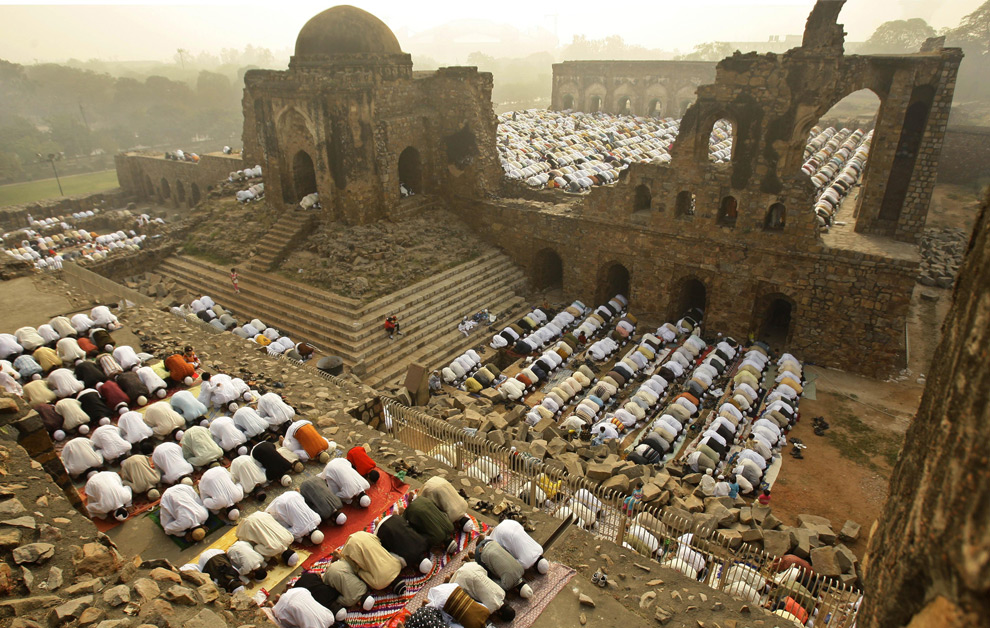
Great Photos: The Hajj and Eid al-Adha via Boston.com

Fantastic set of photo’s of this years Hajj (Muslims Pilgrimage) and Eid-Ul-Adha (Day of Sacrifice)

You can have a look at the full set here: The Hajj and Eid al-Adha – The Big Picture – Boston.com

In New Delhi, India, Muslims offer Eid al-Adha prayers at the Ferozshah Kotla Mosque on Tuesday, Dec. 9, 2008. (AP Photo/Gurinder Osan)

28
Oct
08

A Shared Culture

Picked up this post from Mohamed’s blog…. Great video from Creative Commons.

28
Jul
08

iCommons iSummit 2008

I’m getting ready to head over to the iCommons iSummit
this year in Sapporo, Japan. I’m going to be doing some video shooting
on my shiny new Nokia n82 to help document the DIY Video track….

I’ll be updating my twitter/flickr while im there….

iSummit2008 Sapporo

11
Jun
08

Mobile Web 2.0 Summit 2008

I’m currently attending the Mobile Web 2.0 Summit in London. I’m trying to live blog via twitter, so follow me if you want to be updated: http://twitter.com/riy


Flickr Photos

Houses of Dadaab

Houses of Dadaab

People of Dadaab

More Photos

Twitter

Categories


Follow

Get every new post delivered to your Inbox.