Archive for the 'Social' Category

02
Sep
11

Without a # Tag. Somalia.

I’ve recently returned from a trip to Dadaab, the world’s largest refugee camp. I was asked to join the Al Jazeera Director General on this trip in order to help create greater awareness about the situation through “new media” tools. Having read about the stories coming out of Somalia and looking through a ton of photo galleries and videos I thought that I had somewhat prepared myself for the trip.

I could not have been more wrong.

For the first time in my life, I now know what it means when people say “words cannot describe what I’ve seen.” It was tough. Very tough. The people who make it to Dadaab are the “lucky” ones – others have perished on the side of the road, on their way to Dadaab.

The stories that were told were… devastating. Parents having to decide which child to leave behind so that they could make sure the fittest would be able to make it to camp. Imagine having to leave your weakest child behind, on the side of the road, to die. That’s it. Left for the vultures. The lucky ones will die before and at least get a burial. Another told a story of how his baby had to breast feed of his dead wife so that they could have enough strength to go on with the journey.

I felt ashamed to call myself a human being.

There are countless more stories like this, they’ve been told over and over and over. The thing that has hit me most about this, is that it’s not new. Dadaab has been around for over 20 years. Famine and drought are known to occur in these places, yet year after year people are dying of starvation.  Why?

As I sat down on my comfy hotel bed back in Nairobi (only an hour flight away), realising the cruel irony of having a rain shower in the bathroom was a bit too much too handle. We are all living so close to this disaster. In 2011, with all our technology and knowledge, we’re not able to stop people from dying of starvation? That’s hard to believe. How have we as humanity failed these people? We have tons of donations*, but often our donations go without a sense of purpose and attachment to the story. Sending aid does not deal with the core issues that exist. People will get the aid today, what about tomorrow, next month, 5 years from now?  (*the aid that is going is far from enough)

We met people standing in queues to just get one meal for the day. People who are fighting for the right to live. For human dignity. For just a chance. That’s all they want. A chance at life.

Looking into the eyes of children you always get a sense of joy, a sense of optimism that can defeat anything. When I looked into the eyes of some of the children in the camps they looked defeated, worn out, life had taken its toll on them. I’m talking about children who are not older than 3 years old. They’re still the lucky ones. Seeing babies who are malnourished, children without the strength to even stand. The skeletal structure of a living human. This is Dadaab. This is our problem.
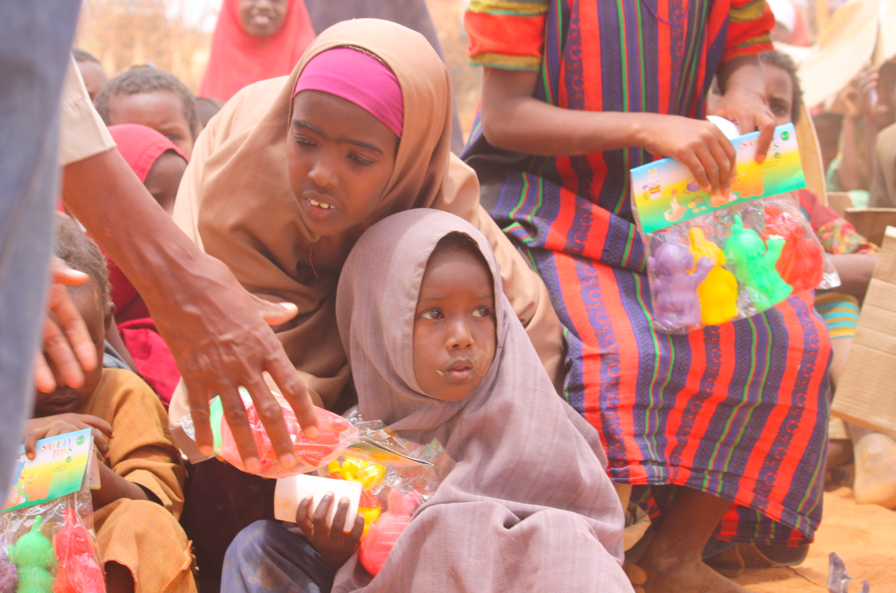
Yet, the story goes mostly unnoticed. Once in a while people will talk about it in the media, there will be hype for a bit, and then the search for a new story moves on. And we forget that the old story has not ended. In fact it’s grown to proportions beyond anyone’s imagination.

With the world of Social Media, everyone likes to talk about how technology can overthrow governments and change the world. How it can mobilise people around a cause almost instantaneously. How we always know what is happening, at any time, anywhere in the world.

Not this world.

When people have not eaten for weeks, have just enough cloth to cover a bit of their body, the last thing that is going to happen is for them to start a revolution with a # tag to get the world’s attention by telling their own story. They need us to do it for them. They need us to be the ones to show the world what’s happening.

As I type this, the trending topics on twitter look something like this:

I don’t actually think that I’ve ever seen Somalia trending on twitter. Ever. Will the world only pay attention when it makes it to the top of the trending topic list? When it gets it’s own special # tag? When it becomes “cool” to join a cause? Maybe if lady gaga was to visit Somalia it’ll trend? She could maybe take her meat dress with her and put it to good use?

What is happening in the world is real. The stories out of Somalia are not some movie. Visting Dadaab felt like I was going to a different planet. I still can not believe that a couple of hours away from me, someone is about to die because they do not have enough to eat. It’s just so real. A realness that’s disturbing, that’s uncomfortable. One that is easy to pass on as not our problem, because if we acknowledge it, the sheer weight that falls on our shoulders to make a difference becomes frighteningly unbearable.

I type this while I’m sitting at home, with my fridge stocked, countless food places to get food from and with the luxury of eating to enjoy the taste of the food. Where did it all go wrong? How can we, as humanity, sit back and let this continue? We have all seen the videos. We have seen the pictures. We’ve heard the stories. What are we going to do about it? At the very least let’s tell the world what’s going on. Be the # tag the people in Somalia need us to be, for the sake of our humanity. If we cannot even get #somalia to trend, then I’m scared for what the future holds for us as a human race.

If only we paid as much attention to the African Summers as we did to the Arab Spring.

14
Jan
11

The revolution was televised, you were just watching the wrong channel.

One of the reasons I decided to post about this was this article on TechCrunch: The #Tunisian Revolution Wasn’t Televized, But You Could Follow It On Twitter

The first tweet that show’s up on the page is really the point behind this post.

The revolution was televised, you were just watching the wrong channel.

There is a lot to say about the role Social Media played in this, I do think that a lot of people seem to be missing the point on what exactly Social Media can and does do in shaping events. Think back to the Iran Elections and how the lack of context really sent many main stream media organisations down the wrong path on how to cover an event using stories from social networks. If my memory serves me correctly, at one point during the IranElections we had over 250,000 tweets using the tag #iranelections – I wonder how many tweets came out about #sidibouzid?

In Tunisia, it was not about mobilising people through Social Media, it was about broadcasting what was going on to those who chose to listen. Without the tweets, facebook posts or YouTube videos we would not have known about the initial protests… or would we? Only once mainstream media picks up on a story and decides what importance it should have, do people really notice what is going on (Iran Elecations case in point). Tunisia has been developing for the past 29 days – but only now do people seem to really notice it, once they’ve seen the news on their local television station. People still turn to mainstream media to get their information. The challenge is in what mainstream media would consider to be important news… The techcrunch article has a couple of other good tweets discussing what other media organisations in the US were talking about during the events earlier in Tunisia.

Evgeny Morozov has a great post on the this topic and it is well worth a read.

If you only found out about the events in Tunisa in the past 24hours, perhaps its time for you reconsider who you get your news from? A good start would be to check out the amazing coverage our web team has been working on since the events started almost a month ago over here.

And if you dont want to miss the next big story because your twitter trends didn’t tell you about it, you may want to set Al Jazeera as your homepage, or follow us on twitter or follow us on facebook.

06
Nov
09

#media140 Sydney – Presentation

My presentation at #media140 in Sydney – Al Jazeera’s online coverage of the #gaza war… which also earned me a pretty cool blog post from the guys at the conference: http://media140.org/?p=722

You can watch the case study on #Gaza here: http://www.ustream.tv/recorded/2498513 (I’ll post a direct shorter link once its online)

The session I presented on Iran can be watched here.

You can also find my comments regarding the importance of context in #iranelection here.

Congrats to the media140 team for putting on a great show.

02
Aug
09

Providing Context: The role of Social Media in Iran

This post is pretty late, but here is one of the interviews I had on Al Jazeera English discussing the role of social media in Iran.

One of the key points I bring up in my interview is the importance of placing the information in context. Towards the end of the mass protests, the number of twitter accounts that we were monitoring dropped from 60 to around 6 (accounts we able to verify). Whilst the information coming out was amazing to show the government clamp down on protests, it is an incredible stretch to say that the information was a reflection of sentiment for the entire population of Iran (over 65million people).

There are two important events that we need to look at.
1) The actual outcome of the election. Did Ahmadinejad win? Do the majority of Iranians feel the election results were incorrect? Its important to note that the protestors are not anti regime, they want reform, but reform within the current system.
2) The protests and the government clamp down on protestors. This is a focus on Mausavi supporters, who felt the results were incorrect. This what is generating the bulk of the discussions online.
Whilst these two events are related, the information that was coming out online is specific to the second event. Once the government started clamping down on the protestors, social media played a critical role in getting the information out.

It is important to understand who are the ones that are sending out the information, what are their backgrounds, where do they come from etc. Harvard provides an excellent analysis on the Persian Blogosphere – the reformists do have a much larger share of the online voice than the conservative voices. There is also a very big percentage of Iranians living outside of Iran who are online, blogging about situation. Ahmadinejad supporters are from the poorer, less connected section of Iran. As such a big percentage of them do not have any access to the internet at all. Their voices are not heard over social media, as such we are only getting one side of the story.

Where social media wins, is the ability to report on the what and when. As events unfold, the immediacy of new technologies allows people on the ground the opportunity to get their voices out. In the case of Iran, it was used very effectively to show the government clamp down on protestors.

Where social media fails, is its inability to provide context and answer the why behind each event. It also does not provide a true representation of the entire population, as the majority of the voices online reflect a minority of the population. The majority of the online population in Iran come from a wealthy, educated background and from the big cities such as Tehran (Mausavi supporters). This is contrasted with the poorer, not connected Ahmadinejad supporters, who are based in the smaller towns and rural areas. When we are dealing with developing countries, we often forget that the majority of the population have no access to simple communication tools, let alone social sites.

A colleague of mine, Mohamed Nanabhay, brought up an interesting point regarding the South African elections earlier in the year. If you were to look at the twittersphere or blogosphere prior to and on the actual election day, you would think no one had voted for the ANC. However the ANC holds popular support amongst the majority of South Africans, the majority of whom are not online.

All of this can be summed up in a tweet that I read recently, it was a quote from Ferial Haffajee on two South Africas: “You have one South Africa tweeting and the other South Africa not eating”

This is the reality of the world we live in. Not everyone is connected. There is a need for us to dig deeper if we truly want to understand the nature of events.

If you want to read up in more detail on the actual role of twitter in Iran, Gaurav Mishra provides a great analysis on the role of twitter. His post also has an extensive list of links to other blogs who have discussed the same issue.

23
Jan
09

The War of Words: #Gaza – The role of New Media

I was asked to write an article for the Al Jazeera website on the current “war of words” that has taken place online during the conflict in Gaza…

Here is a copy of the article “Waging the web wars”

Waging the web wars

Propaganda has always played an important role in the way war is waged.

Using the available traditional media platforms – such as television, radio and print – governments have battled for mindshare in an attempt to convince the public that military engagements are serving their best interests.

Over time, new communication technologies have forced governments to realign their propaganda campaigns.

In the modern age of warfare, government spokespersons have provided major news networks the opportunity to engage, question and dissect domestic, foreign and military policies.

However, the recent war in Gaza has pushed the boundaries of traditional media as the debate on the conflict opened a new front – online.

Though television has continued to provide viewers with in-depth coverage of the conflict, it did not sufficiently allow the average, frustrated person on the street to express their views.

War of words

Enter the “social” internet – currently termed “War 2.0″ or “War of Words” – where people from around the world used social networking websites such as Facebook, Twitter and YouTube to express their opinions to a global audience.

With the internet becoming a battleground of ideas, the average person, armed with a keyboard and an internet connection, became a participant in the conflict.

On December 27, 2008, Israel launched ‘Operation Cast Lead’ against Hamas targets in the Gaza Strip. Within minutes of the first missile landing in Gaza, global reactions appeared online.

During the first few days of the war, online discussions were restricted to war of words. Both sides engaged in heated debates and blamed each other for the fatal surge in military operations.

As the discussions grew, attempts were then made by supporters of both sides to establish a coordinated response aimed at combatting the other side’s propaganda.

With this awareness in mind, both Israel and the Palestinians resorted to a variety of media platforms to justify their positions and tactics used during the conflict.

Israeli supporters set up the Help Us Win website, and some Palestinian supporters created Gaza Talk.

Hundreds of groups were created on Facebook by Israelis and Palestinians to create an awareness of the facts as they saw them.

Israeli government reacts

The Israeli government also attempted to capitalise on the online conversations.Realising the importance these mediums play in the propaganda war, they held an unprecedented press conference on Twitter.

The Israeli army also set up a YouTube channel and uploaded videos of some of their air raids on Gaza.

While no official online presence has been established by Hamas, pro-Palestinian supporters have been using videos and images to effectively deliver their message.

The Israeli army showed simple black-and-white videos (without audio) of Hamas-launched rockets, while Palestinians offer vivid videos and images of the chaos and destruction on the ground in Gaza following Israeli air raids.

However, the images from Gaza allowed pro-Palestinian supporters to dominate this online war.

More engaged audiences

The battle to gain public favour is becoming increasingly difficult as governments try to meet the challenges of dealing with a more engaged audience.

On Facebook, hundreds of thousands of people have signed on pro-Israeli and pro-Palestinian groups.

The group Let’s Collect 500000 Signatures to Support the Palestinians in Gaza has 630,002 members while the I Support the Israel Defence Forces In Preventing Terror Attacks From Gaza group has 85,308 members.

On Twitter, the tag “#Gaza” has been in the top 10 trending topics since the Gaza war began on December 27.

As the propaganda war enters a new phase, governments now need to fully embrace these new technologies and use them to their benefit.

Until then, online social communities will continue the debates which will likely last well beyond the current war in Gaza.

07
Jan
09

Al Jazeera New Media….

Following on from my last post- I was asked to go on air again to talk about our new interactive map (second appearence on AlJazeera)… Incase you’ve missed it, our new services are proving to be a fantastic tool in covering the war on Gaza. If you don’t believe me check out what WIRED and NPR had to say….

Getting tweets from the war zone is so 2008. The latest social media advance combines tools like Twitter, text messaging, and online mapping to gather up first-hand reports, straight from Gaza.

Oh and the CEO of twitter, EV,  sent out a message referring to our Gaza Twitter Stream….

picture-141

Getting reviews online is always comforting- however the circumstances under which we rolled out these services aren’t. Lets hope and pray that the killing comes to an end and crisis reporting will no longer be needed…

Here is my interview on AJ:

02
Jan
09

Al Jazeera – Mapping out the Gaza conflict

After a few late nights at the office we have finally launched our interactive map for the situation in Gaza. The folks over at Ushahidi have been fantastic in allowing us to use their crowd sourcing platform for this project…. Our SMS system was set up and is powered by the guys at souktel (thanks to @Katrinskaya from MobileActive for putting us in touch with souktel)

The Ushahidi Engine is a platform that allows anyone to gather distributed data via SMS, email or web and visualize it on a map or timeline. Our goal is to create the simplest way of aggregating information from the public for use in crisis response.

War on Gaza

As updates come in on the situation in Gaza, we update the map with the incident. People can have a look at the timeline and map to get a idea of how the entire event has played out from the beginning. The great thing about this platform is the “crowd sourcing” part… People in Gaza and around the world can submit reports through to the site in 4 ways:

1) Report an incident directly at: http://labs.aljazeera.net/warongaza

2) via SMS (text message) – If you’re in Palestine and on the Jawwal network, you can text in your report to the number: 37191

or if you’re anywhere else in the world you can send a text to: +45609910303

All messages need to start with the word GAZA so that we can track it… (eg: GAZA 5 aid trucks just arrived at the Rafa crossing)

3) If you’re on twitter*, you can submit a report by simply replying to our official AlJazeera account with your report @AJGaza (eg: @AJGaza airstrike just resumed in Khan Yunus)…

*If you still dont know what twitter is head over to CommonCraft and watch the great video that explains it

4) If you have images or video, you can email them through to us at yourviews@aljazeera.net or upload them here.

I do wish the war ends soon so we dont have to actually test the platform out…. With the way its currently looking the end is not in sight, so lets just hope we can provide a great resource of information for the war.

Big ups to the other guys in our New Media team who worked through the nights to get this up…. Its amazing what one tweet can do (got in touch with @whiteafrican via twitter for this)

You can read more about the deployment on the Ushahidi Blog

14
Nov
08

Collaborative Education

Over the past few months I’ve been having discussions with a couple of people in the education field. The concept of “open education” came up and seemed to be great idea that could allow institutions, teachers, pupils and the community to share and start discussing their thoughts & challenges. The concept was to allow schools to use online tools (possible wiki concept) as a means to start sharing their syllabi and best practices. The natural challenge is to first get a school to buy into the concept… I was successful in convincing two principals in South Africa to buy into it, unfortunately my trip to SA came to end prior to having a chance to actually implement the idea. I’ve now got some friends on board, hopefully they can take it over and run with it… I’m sure this is already happening elsewhere in the world- need to do some serious research to find success cases…

A friend forwarded this link through to me, the “Social Media Classroom” – I haven’t had a chance to go through it in much detail, but the concept is fantastic. Seems like something def. worth having a play around with… Technology is always just a tool for us, and if used correctly it can really bring about constructive change.

The Social Media Classroom (we’ll call it SMC) includes a free and open-source (Drupal-based) web service that provides teachers and learners with an integrated set of social media that each course can use for its own purposes—integrated forum, blog, comment, wiki, chat, social bookmarking, RSS, microblogging, widgets , and video commenting are the first set of tools. The Classroom also includes curricular material: syllabi, lesson plans, resource repositories, screencasts and videos.

06
Jun
08

Who Will Rule the New Internet?

Came across this article on the TIME website, its about “Who Will Rule the New Internet?”

Its def. worth a read….

According to Josh Quittner, Apple, Google & Facebook are the technology standard-bearers of todays age. Google- with its “open” web, Facebook- with its huge user base and “walled” off approach & Apple- with the highly controlled “experience.”

The article goes on to explain the success & strategies of three companies, one of the interesting points he raises with regards to Googles “Open” Web strategy VS Facebook is:

Social networks are a threat to that business; users tend to stay within their network and communicate among themselves or simply fool around with apps. When Facebook’s users are playing Scrabulous or tagging photos, for example, they’re not using Google. Indeed, they’re more likely to discover new things via friends or in-network applications such as iLike, a service that matches your friends’ musical tastes to your own.

The flaw in this theory is, facebook may be the biggest thing today, what happens when users get bored and start moving on to the next big site? It was MySpace yesterday, today its Facebook, tomorrow its going to be twitter? Or a microblogging site similar to it? The life cycle on a specific social networking site is still to be decided. Users are like sheep, and who is to say next year we wont see a mass migration to something completely new that has not even been developed yet?

According to Josh, Apple doesnt really care who wins the online war- as long as we use an Apple device to access the content. He quotes Matt Murphy (a venture capitalist) as saying:

He claims that the iPhone will “absolutely be the driver of the post-PC world.” Murphy points out that the kit needed by developers to build iPhone apps has been downloaded more than 200,000 times, and he estimates that about 1,000 applications will be available to consumers when the iPhone-apps store launches with the phone. “If you look at so many of the constraints that have held back the mobile ecosystem, Apple basically takes all of those away and provides an open platform, a great device and a user base that’s rabid for these new kinds of applications,” he says.

The best part of this article, is that Josh did not forget to mention Android. Googles open mobile platform that is due to hit the market place later this year. Andy Rubin, Googles Director of mobile platforms says:

Developers have so far written more than 1,800 applications, which could be distributed on a Google site arranged according to popularity, as YouTube is. “There’s some pretty innovative stuff there,” Rubin explains. “This is merging the handset and the Web and coming up with something completely new.

We’re in for an exciting second half of the year, with the iPhone 2 coming out in a couple of days & Android later in the year, its going to be very interesting to see which company will take the market by storm. Two companies, with very different go-to-market strategies. The problem Google may have, will be the actual device Android is running on… They have already signed deals with many companies (Moto, LG, HTC etc.), but if these companies are not able to provide a compelling UI like the iPhone, this would most likely see users moving towards the iPhone.

Nokia are also due to launch the N96 later this year, i’m sure Nokia will sell the most handsets, but their market share will be sure to take a bit of a knock with some serious competition from Android & Apple. For myself, this is the first year that is a seriously tough decision on which handset to buy? Will Nokia be able to come up with a device that provides a compelling user experience like what we have seen so far from Android and Apple? I doubt it. Regardless of who wins, its great to finally have some quality devices coming to market.

I suppose Google still has a 1 up on Apple & everyone else in the market- anyone who lands up buying an iPhone/Nokia will in the end, still be using Google/Youtube on their handset.

As for the battle of the internet, if Google actually own the platform on which you’re accessing facebook or the next big thing on your mobile, they dont have much to be worried out. At least in the short term…

Lets wait and see how this plays out in the coming months….


Flickr Photos

Houses of Dadaab

Houses of Dadaab

People of Dadaab

More Photos

Twitter

  • In other news, I'm in San Francisco for the next 2 months, building our online video channel. Bay area ppl let me know if you want to meet. 1 day ago
  • Can't use Skype on a Google Pixel - anyone figured out a good workaround? 1 day ago
  • Discovered the awesomeness of @Uber in San Francisco thanks to @safdar - fantastic service. 1 day ago

Categories


Follow

Get every new post delivered to your Inbox.